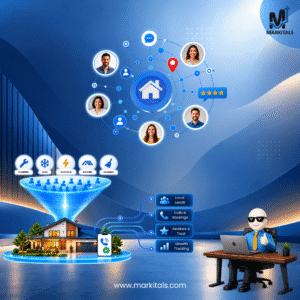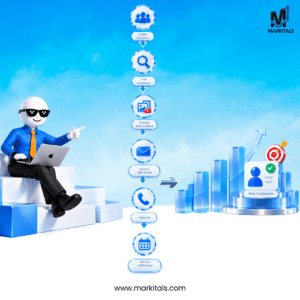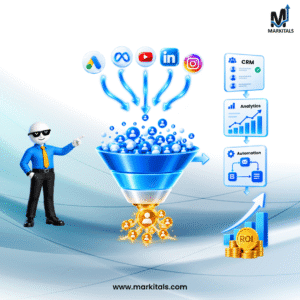

A full-funnel growth strategy isn’t just another marketing buzzword — it’s the foundation of sustainable, scalable business growth. It focuses on guiding potential customers through every phase of their journey, from the first moment they become aware of your brand to repeat purchases and long-term advocacy.
Marketing should not be treated as a collection of isolated campaigns. Growth is engineered by intentionally connecting awareness, engagement, conversion, and retention into one cohesive, performance-driven system that consistently moves prospects toward revenue and long-term value.
What Is a Full-Funnel Growth Strategy?
A full-funnel growth strategy is a unified marketing approach that addresses every stage of the customer journey — attracting the right prospects, nurturing interest, converting intent into action, and retaining customers well beyond the first transaction.
Instead of focusing only on traffic generation or short-term conversions, a full-funnel strategy ensures that each stage prepares the customer for the next. Messaging, experiences, and touchpoints are aligned so buyers feel guided rather than pushed. This continuity builds trust, improves engagement, and leads to more predictable, repeatable business outcomes.
Why Full-Funnel Matters for Every Business Stage?
Modern buyers rarely follow a straight path to purchase. They discover brands through multiple channels, research independently, compare alternatives, seek validation, pause, return, and often require several interactions before making a decision.
A full-funnel approach ensures your brand stays relevant, consistent, and helpful throughout this non-linear journey. Instead of losing prospects after initial awareness, you continue supporting their decision-making process. This results in lower acquisition costs, stronger conversions, better retention, and higher lifetime value — while reducing wasted spend across disconnected marketing efforts.
The Real Structure of a Full-Funnel Growth Strategy
In practice, a full-funnel strategy is not a linear sequence of campaigns. It is a connected decision system designed around how buyers think, hesitate, compare, and commit.
The real structure works on three foundational layers:
1. Decision progression, not channel progression
Buyers move forward when uncertainty reduces — not when they see more ads. A strong funnel is built around resolving questions, risks, and objections at the right time, rather than forcing movement between stages.
2. Signal continuity across stages
Every interaction — a blog read, an ad click, an email open, a demo request — generates intent signals. A true full-funnel system uses these signals to shape what the prospect sees next, instead of resetting the experience at each stage.
3. Feedback loops, not handoffs
The funnel doesn’t “end” at conversion. Retention insights inform future awareness messaging. Sales objections inform mid-funnel content. Customer behavior continuously refines the entire system.
This structure ensures the funnel behaves as a growth engine, not a series of disconnected marketing efforts.
How the Full Funnel Works — Stage by Stage
1. Top of Funnel (Awareness): Get Seen by the Right People
Goal: Introduce your brand to the right audience and establish early relevance.
At this stage, the objective is not immediate selling. It’s about educating, positioning, and attracting attention from prospects who genuinely fit your target profile. The focus is on visibility with relevance, not volume alone.
Key activities include Performance Marketing across search and social platforms, educational blog content, organic social presence, brand storytelling, and SEO strategies that surface your brand when users begin researching problems. A strong awareness stage fills the funnel with qualified prospects who are more likely to engage meaningfully in later stages.
2. Middle of Funnel (Consideration): Build Interest and Trust
Goal: Deepen engagement and help prospects evaluate your solution with confidence.
At this point, prospects are aware of your brand and actively assessing whether your solution fits their needs. They are looking for clarity, proof, and reassurance — not marketing hype.
Effective consideration-stage efforts focus on education and credibility. This includes detailed case-style explanations, solution breakdowns, how-to content, email nurture journeys, and retargeting that brings prospects back with relevant context. Lead Generation Solution help turn this interest into a consistent pipeline of qualified prospects. This stage is critical because it transforms passive interest into informed confidence, making prospects far more likely to convert.
3. Bottom of Funnel(Conversions): Seal The Deal
Goal: Make taking action simple, logical, and friction-free.
When prospects are ready to decide, even small points of confusion or friction can cause drop-offs. The conversion stage is about removing obstacles and reinforcing value, not pushing harder.
Strong conversion tactics include clearly structured landing pages, focused CTAs, streamlined forms or checkout flows, timely sales or support interactions, and contextual incentives such as demos or consultations. When the funnel is well-designed, conversion feels like a natural next step rather than a forced decision.
4. Beyond the Funnel (Retention & Loyalty): Keep Customers Coming Back
Goal: Build long-term relationships that drive repeat revenue and advocacy.
A true full-funnel strategy does not end at conversion. Retention focuses on what happens after the sale — ensuring customers continue to see value, stay engaged, and choose your brand again.
Retention activities include personalized post-purchase communication, onboarding and education, loyalty programs, exclusive offers, and community-building initiatives. Retained customers are more cost-effective, spend more over time, and often become advocates — making retention one of the most powerful levers for sustainable growth.
Performance Benefits of Full-Funnel Marketing
A well-executed full-funnel strategy delivers measurable business advantages:
✔ Unified growth engine
Each stage strengthens the next instead of competing for attention. Awareness generates qualified demand, consideration builds confidence, conversion removes friction, and retention compounds value — creating continuous momentum rather than isolated wins.
✔ Better audience alignment
Messaging evolves with buyer intent. Prospects receive information that matches their decision stage, reducing noise and increasing relevance across every interaction.
✔ Reduced funnel leakage
Consistent nurturing prevents drop-offs caused by silence, confusion, or mistimed outreach. Buyers are supported through uncertainty instead of being left to decide alone.
✔ Higher lifetime value
Retention and loyalty strategies extend customer relationships beyond the first purchase. This reduces dependence on constant acquisition and creates more predictable, scalable revenue.
How a Full-Funnel Growth Engine Is Built
A true full-funnel system turns marketing into a connected growth engine, not disconnected tactics. This approach includes:
🔹 Mapping customer journeys
Analyzing how prospects discover your brand, what influences their decisions, and where friction appears — ensuring no stage is ignored or disconnected.
🔹 Aligning messaging across stages
Each touchpoint speaks directly to the customer’s mindset at that moment, improving clarity, trust, and continuity throughout the funnel.
🔹 Integrating paid and organic channels
Paid efforts drive immediate visibility and demand, while organic strategies build long-term authority and reduce dependency on ad spend.
🔹 Data-driven optimization
Every funnel decision is guided by real user behavior, performance data, and conversion signals — not assumptions or vanity metrics.
🔹 Retention and loyalty systems
Post-conversion strategies keep customers engaged, increase repeat business, and turn satisfied customers into advocates.
Clicks and impressions alone do not create growth. Momentum, efficiency, and sustained revenue do.
Final Thoughts
A full-funnel growth strategy connects discovery, evaluation, conversion, and loyalty into one cohesive engine. It transforms fragmented marketing activity into a system that delivers consistent revenue, stronger customer relationships, and long-term scalability.
For modern brands that want precision, efficiency, and measurable growth, full-funnel thinking is no longer optional — it’s essential.
The brands that win aren’t the ones doing more marketing — they’re the ones building better-connected growth systems.
Ready to Build a Full-Funnel Growth Engine?
Markitals helps brands build high-performance marketing systems that connect awareness, lead generation, conversion, and retention into one integrated growth engine designed for measurable, sustainable results.